


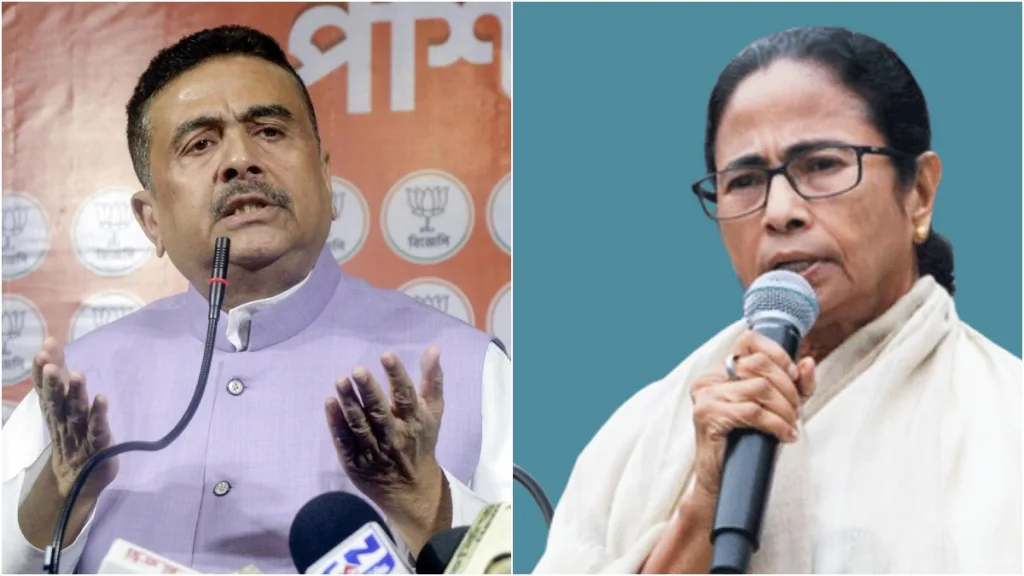
West Bengal’s upcoming Assembly election is being projected as one of the most decisive political contests in India, often mentioned alongside Tamil Nadu and Kerala. However, beneath the noise and national attention, the Bengal election is arguably less transformative than it appears. Unlike states where outcomes can shift national coalition dynamics or significantly alter parliamentary equations, Bengal’s result is more symbolic than structural. Its importance lies in narrative control rather than political arithmetic. For the Bharatiya Janata Party (BJP), it represents an unfinished expansion project. For Mamata Banerjee, it is the defence of her political fortress. Yet, beyond these symbolic stakes, the election does not fundamentally reshape national power structures, making its perceived significance somewhat overstated.
From Multi-Polar Politics to a Two-Person Contest
Bengal’s political landscape has undergone a dramatic transformation over the past decade. Once defined by ideological battles between the Left, Congress and emerging regional forces, it has now collapsed into a bipolar contest between the Trinamool Congress (TMC) and the BJP. Even within this bipolarity, the narrative has narrowed further into a direct clash between Mamata Banerjee and Suvendu Adhikari. The decline of the Left and Congress has removed any meaningful third force, effectively reducing electoral competition to a personality-driven duel. Mamata remains the central axis of the state’s politics, while Adhikari has emerged as the only leader capable of directly challenging her, particularly after his narrow but symbolic victory over her in Nandigram in 2021. The upcoming election, therefore, resembles a presidential-style contest more than a conventional multi-party democratic exercise.

Mamata Banerjee’s Structural Advantage
Mamata Banerjee enters the contest with a set of advantages that go beyond electoral arithmetic. Her strength lies in a deeply entrenched organisational network, coupled with a strong emotional connect with voters. Welfare schemes targeting women, rural households and marginalised communities have created a durable support base. More importantly, Mamata has mastered the art of narrative-building. By framing elections as battles for Bengali identity and federal autonomy, she elevates the stakes from governance to existential politics. This allows her to consolidate support across diverse voter groups, particularly in constituencies like Bhabanipur, where demographic diversity enables her to deploy a layered electoral strategy combining welfare benefits, identity politics and personal appeal.
Suvendu Adhikari: Challenger with Limits
Suvendu Adhikari represents the BJP’s most credible challenge in Bengal, but also highlights its limitations. His insider knowledge of TMC’s organisational structure and his ability to mobilise local networks make him a formidable opponent. His victory in Nandigram proved that Mamata is not invincible. However, his influence remains uneven across the state. While he commands strong regional support, particularly in parts of East Midnapore, he has yet to evolve into a leader with statewide emotional resonance. The BJP’s continued reliance on national leadership further dilutes his positioning as the sole face of opposition in Bengal. As a result, while Adhikari is central to the contest, he does not yet redefine the political landscape in the way Mamata does.

The SIR Factor: Administrative Exercise or Political Weapon?
The Special Intensive Revision (SIR) of electoral rolls has emerged as the most critical variable in this election. Officially an administrative process aimed at updating voter lists, its scale and timing have turned it into a politically charged issue. Reports of large-scale deletions, including tens of thousands of voters removed in key constituencies such as Bhabanipur and significant revisions in Nandigram, have intensified political tensions. The process has effectively shifted part of the electoral battle from the ground to institutional arenas, where questions of legitimacy, fairness and intent are now central to the political discourse.
How SIR Reshapes Mamata’s Strategy
For Mamata Banerjee, SIR presents both risk and opportunity. On one hand, large-scale deletions in her strongholds could weaken her numerical advantage, particularly if they disproportionately affect her core voter base. On the other hand, the issue provides her with a powerful political narrative. By framing SIR as an attempt to disenfranchise voters, she reinforces her image as a defender of democracy and Bengal’s rights. This narrative helps mobilise her support base and convert a potential structural disadvantage into political capital. In effect, even if SIR alters voter arithmetic, it strengthens her emotional appeal and campaign messaging.

BJP’s Calculated Gain, Hidden Risks
For the BJP and Suvendu Adhikari, SIR aligns with their long-standing claims of irregularities in voter rolls. The process potentially benefits them by addressing concerns about duplicate or ineligible voters, thereby strengthening their structural position. However, this advantage comes with risks. If legitimate voters are perceived to have been removed, it could trigger backlash and reinforce Mamata’s narrative of institutional bias. Additionally, an over-reliance on SIR risks overshadowing the need for grassroots mobilisation, an area where the BJP continues to lag behind the TMC. Thus, while SIR offers structural gains, it also exposes the BJP to political vulnerability.
The Geography of the Contest: Symbolism Over Spread
The electoral geography further highlights the personalised nature of the contest. Nandigram symbolised Adhikari’s rise and Mamata’s momentary vulnerability, while Bhabanipur represents her consolidation and recovery. By challenging Mamata in her own stronghold, Adhikari has elevated the stakes of the election. However, this also places him on terrain where Mamata’s organisational depth and emotional connect are strongest. The battle is no longer about defending individual strongholds but about redefining political dominance in symbolic constituencies that carry disproportionate weight in shaping public perception.
Who Holds the Edge?
A rational assessment suggests that Mamata Banerjee retains a slight but decisive edge. Her advantages are systemic: a broader voter coalition, deeper organisational reach and the ability to convert administrative challenges into political narratives. Adhikari’s strengths, while significant, remain contingent on translating symbolic victories into sustained electoral gains. His success depends heavily on whether the BJP can convert structural advantages, including those offered by SIR, into actual voter consolidation. This remains an uncertain proposition, given the party’s organisational limitations in the state. A Presidential Election in Disguise
What makes the Bengal election distinctive is its increasing resemblance to a presidential contest. The absence of strong third forces has concentrated political power and attention in the hands of two leaders. Campaign narratives, voter mobilisation and media coverage all revolve around Mamata Banerjee and Suvendu Adhikari, overshadowing party structures and policy debates. This shift reflects a broader trend in Indian politics where leadership personality increasingly dominates electoral outcomes.

A Duel, Not a Democratic Spread
Ultimately, the 2026 West Bengal election is less a multi-dimensional democratic contest and more a tightly confined duel between two leaders. The SIR process has added unpredictability, but it has also exposed the fragile balance between administrative mechanisms and political narratives. While the election continues to attract national attention, its core remains a personalised battle that overshadows broader political dynamics. Mamata Banerjee, with her entrenched advantages, enters the contest as the frontrunner, while Suvendu Adhikari remains the only challenger capable of altering the equation. Beyond this rivalry, the rest of the electoral landscape carries limited strategic weight. Everything else is, at best, peripheral to the central contest.