


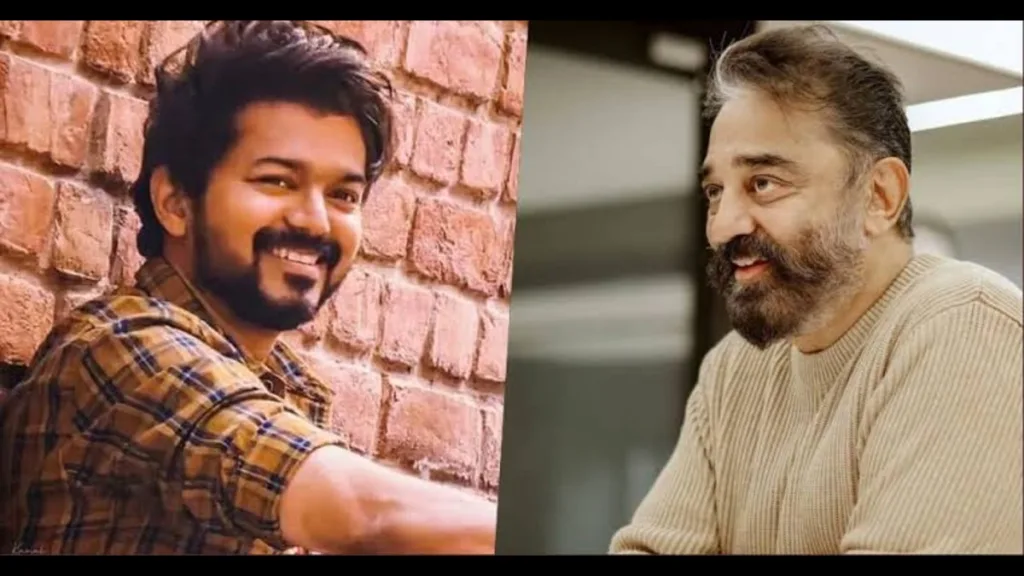
Actor-politician Kamal Haasan has responded to ongoing discussions around actor Vijay’s political ambitions, stating that he has more pressing matters to focus on as Tamil Nadu gears up for its next electoral cycle. His remarks come amid heightened political chatter surrounding Vijay’s party, Tamilaga Vettri Kazhagam (TVK), and its potential impact on the state’s political landscape.
Kamal Haasan, who leads the Makkal Needhi Maiam (MNM), was asked about Vijay’s growing political presence and whether it posed a challenge or concern. Addressing the question, Haasan made it clear that his priorities lie elsewhere. He indicated that his focus remains on his own political agenda and the issues he aims to address, rather than on the activities of other political figures.


The veteran actor emphasised that politics is not about reacting to individuals but about serving the public and addressing systemic challenges. He suggested that his attention is directed towards policies, governance, and the long-term vision he has for Tamil Nadu. By doing so, Haasan appeared to distance himself from direct comparisons or competition with Vijay.
Vijay’s entry into politics has generated significant interest, especially among younger voters and his fan base. With the formation of TVK, the actor has signalled a more structured political approach, leading to speculation about how his presence could reshape electoral dynamics in the state. However, Haasan’s response indicates that he does not view this development as something that requires immediate reaction.
The political environment in Tamil Nadu has traditionally been dominated by major parties such as the DMK and AIADMK, but the emergence of new players like MNM and TVK has added fresh layers to the contest. Observers have been closely watching how these newer entrants position themselves and whether they can carve out a significant voter base.


Haasan’s remarks also reflect his attempt to maintain a distinct political identity. Since launching MNM, he has consistently highlighted governance reforms, anti-corruption measures, and citizen-centric policies as key pillars of his approach. By steering the conversation away from personalities, he reinforced his focus on issues rather than rivalries.
At the same time, the intersection of cinema and politics in Tamil Nadu continues to be a defining feature of the state’s public life. Both Haasan and Vijay command substantial influence as film stars, which naturally translates into political attention. This overlap often leads to comparisons, even when the individuals involved may prefer to chart independent paths.
While Haasan refrained from engaging directly with Vijay’s political trajectory, his comments have not gone unnoticed. Political analysts suggest that such statements are part of a broader strategy to avoid unnecessary confrontations while maintaining focus on core campaign themes.
As Tamil Nadu moves closer to its next elections, the spotlight is likely to remain on emerging political narratives and alliances. Vijay’s political journey is still in its early stages, whereas Haasan has already contested elections and established a party structure.