


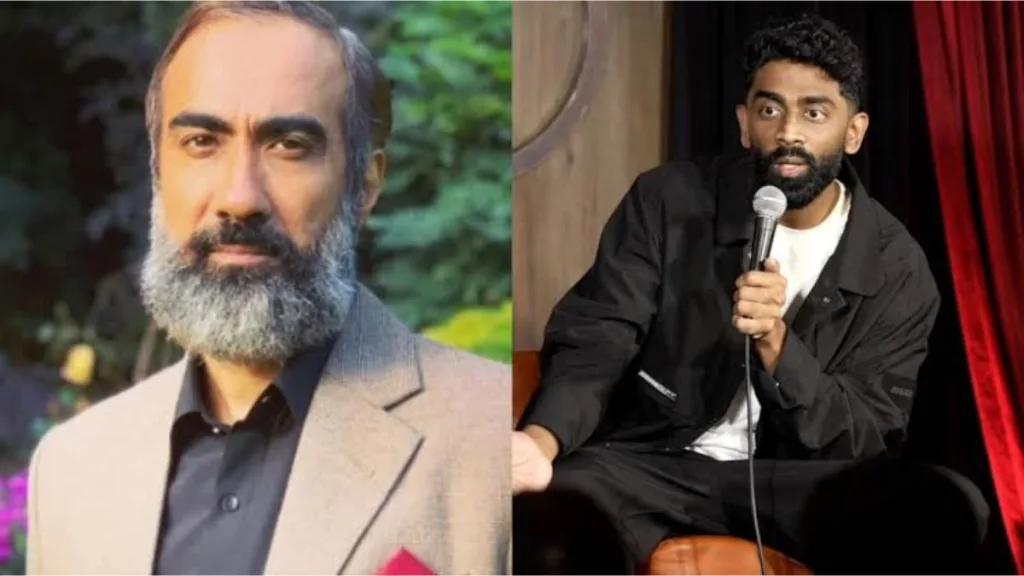
Actor Ranvir Shorey has come out in support of comedians amid the ongoing controversy surrounding stand-up comic Pranit More and the viral ₹370 biryani remark that has dominated social media discussions over the past few days. Shorey expressed concern over what he described as a growing tendency to blame comedians for everything said during live performances, arguing that comedy should not be treated as a target whenever public outrage erupts.
The controversy began after a clip from one of Pranit More’s crowd-work shows went viral online. During the interaction, audience member Himanshu Jangra spoke about spending ₹370 on biryani during a date and made remarks that many viewers considered misogynistic. The video quickly spread across social media platforms, sparking criticism not only of Jangra but also of More, with some accusing the comedian of failing to challenge the comments strongly enough.


As the backlash intensified, the incident expanded beyond the original exchange. Jangra faced widespread online criticism and eventually lost his job after the controversy gained national attention. More later issued a public apology, acknowledging that he could have handled the situation differently. The debate soon evolved into a larger conversation about comedy, accountability and the responsibilities of performers during audience interactions.
Reacting to the controversy, Ranvir Shorey said that comedians should not automatically be held responsible for every statement made by audience members during live shows. According to him, crowd-work comedy relies heavily on spontaneous interactions, making it impossible to predict every comment that may emerge from the audience. He suggested that people often misunderstand the nature of live comedy performances, where improvisation is a central element.


Shorey argued that societies that fail to respect comedy ultimately risk losing an important space for free expression and social commentary. He noted that comedians frequently explore uncomfortable subjects and challenge social norms through humour, which has historically been one of the functions of comedy across cultures.
The actor’s comments arrive at a time when comedians in India have increasingly found themselves at the centre of controversies. Several stand-up performers have faced criticism, legal complaints or online campaigns over jokes, observations or crowd interactions. The trend has fuelled debates about where the boundaries of comedy should be drawn and how much responsibility entertainers should bear for audience reactions.
While Shorey did not endorse the controversial remarks that sparked the backlash, he appeared to caution against conflating the actions of audience members with those of performers. He suggested that assigning blame too broadly could discourage comedians from engaging in spontaneous crowd-work formats altogether.


His remarks have generated mixed reactions online. Some users agreed with Shorey’s position, arguing that comedy shows should not be treated as formal debates where performers are expected to challenge every opinion expressed by audience members. Others maintained that comedians have a responsibility to intervene when comments cross ethical or social boundaries, particularly in front of large audiences.
For Shorey, however, the central issue appears to be the place of comedy in society. His comments suggest a belief that while comedians can certainly be criticised, they should not be treated as the sole culprits whenever controversial opinions emerge during a live performance. As discussions around the ₹370 biryani row continue, his intervention has added another perspective to an already polarising debate.