


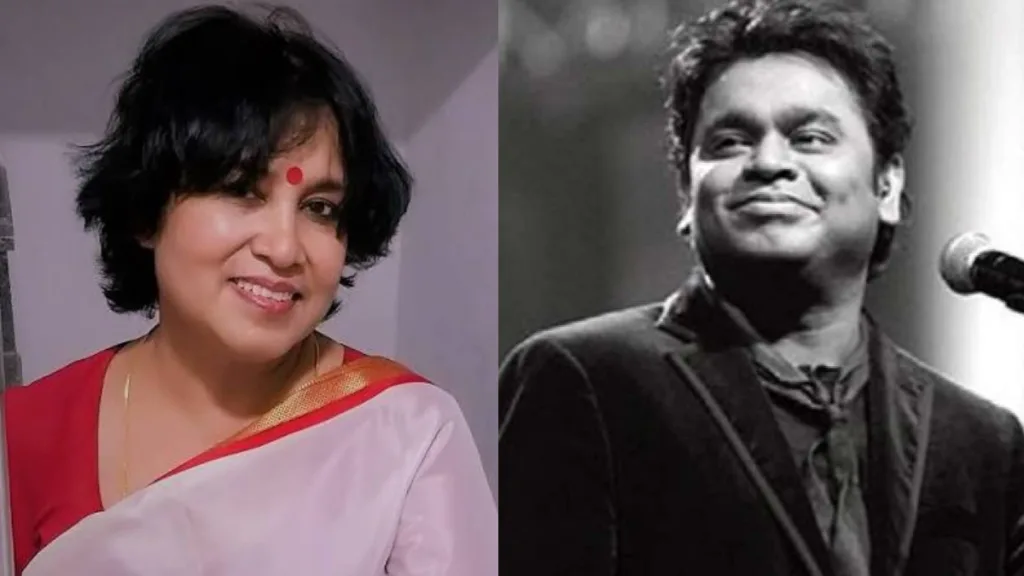
Author and social commentator Taslima Nasreen has criticised composer A.R. Rahman for remarks he made about shifts in Bollywood’s power dynamics, suggesting some changes could be “communal.” Nasreen’s response drew on her own observations about the Indian film industry and referenced the continued success of actors Shah Rukh Khan and Salman Khan as part of her rebuttal.
Rahman had recently spoken about how broader societal attitudes might influence creative industries, including cinema. In that conversation, he noted that power structures in Bollywood seem to be shifting, and added that some of these shifts could be linked to communal forces, reflecting wider social changes. His comment was interpreted by many as a recognition that cultural and societal influences often ripple into artistic spaces, not necessarily as accusations but as observations about correlation between public discourse and entertainment trends.

In response, Taslima Nasreen challenged Rahman’s framing, arguing that his use of the term “communal” was inappropriate when applied to the context of Bollywood’s current environment. She took to social media to express her views, suggesting that the careers and sustained popularity of figures like Shah Rukh Khan and Salman Khan, two of Indian cinema’s most influential and diverse stars, run counter to any assertion that the industry is succumbing to communal influence.
Nasreen pointed out that both Khan and Salman have maintained appeal across communities and audiences, transcending divisions on the basis of religion or identity. She said that their box office success and continued relevance suggest that Indian audiences embrace artists for their craft rather than for communal affiliations. In her view, the presence of such broad-based popularity is a testament to the inherently diverse and inclusive nature of mainstream cinema audiences.


She also questioned whether Rahman’s remark might inadvertently feed into narratives that oversimplify how cinema functions in a multicultural society. Taslima argued that cinema reflects a multitude of influences, artistic, economic and cultural, and reducing power dynamics to communal explanations might overlook other key factors such as audience preferences, changing storytelling styles, and shifts in distribution and consumption patterns.


Nasreen did not deny that societal trends exist outside cinema, but she insisted that translating those trends into artistic intent or industry power structures requires clearer evidence. She said that attributing power shifts to communal forces could be “misleading” if not backed by broader analysis, and emphasised that cinema today is shaped by complex variables including global influences, digital platforms and artistic experimentation.
Her remark drew varied reactions. Some followers agreed with her assessment, arguing that the enduring popularity of artists like Shah Rukh and Salman reflects deep audience loyalty that transcends communal categorisation. They noted that both actors have long careers built on wide appeal rather than niche alignment, and added that their films continue to draw viewers from diverse backgrounds.


Others, however, supported Rahman’s original point, suggesting that public discourse and cultural context inevitably influence creative industries. They argued that commentary from artists like Rahman, who work across multiple cultural spaces, can open up necessary conversations about how external societal pressures find expression in entertainment.
The discussion underscores a broader debate about how cinema and culture intersect with societal currents. While some see cinema as a reflection of broader social dynamics, others emphasise its independent artistic value and the role of audience choice.