


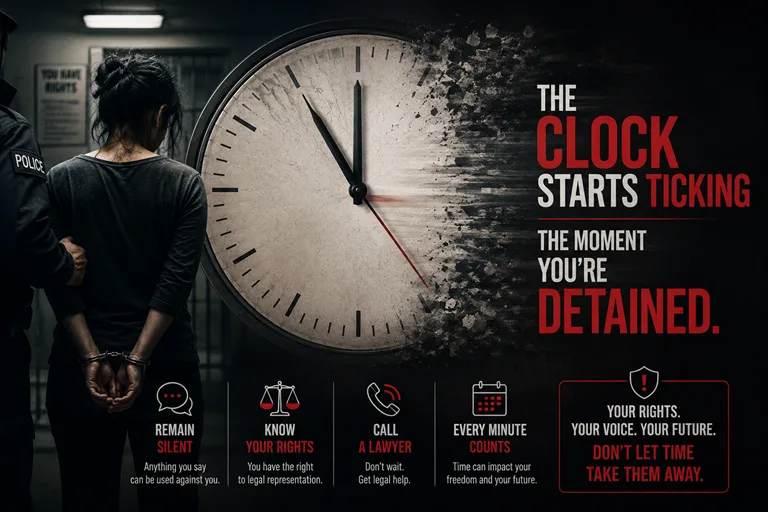
Most people have a general sense that police can’t hold someone forever without a reason. Beyond that, though, things get fuzzy pretty quickly. Ask ten people how long officers can keep someone detained, and you’ll probably get ten different answers.
Part of the confusion comes from the fact that not every police encounter is the same. A brief roadside stop, a criminal investigation, and a formal arrest all involve different rules. What applies in one situation may not apply in another.
That’s why people often search for how long can police detain you after an encounter with law enforcement. The answer depends on the circumstances, but there are constitutional limits on how long a detention can last and what officers can do during that time.
A Detention Is Not The Same Thing As An Arrest
One of the biggest misunderstandings involves the difference between being detained and being arrested. The two terms are often used interchangeably, but legally they’re not the same thing.
A detention is generally a temporary stop that allows officers to investigate a situation. During that period, a person may not feel free to leave, but they have not necessarily been placed under arrest.
An arrest is a more significant step. It usually means officers believe they have sufficient legal grounds to take someone into custody and begin the formal criminal process.
The Constitution Places Limits On Police Authority
The Fourth Amendment protects people from unreasonable searches and seizures. That protection applies not only to arrests but also to investigative detentions.
In general, officers cannot extend a detention indefinitely while hoping to discover evidence of a crime. The amount of time must usually be connected to the purpose of the stop and the investigation being conducted.
Courts often look at whether officers acted reasonably under the circumstances. A brief detention for a legitimate purpose is one thing. An unnecessarily prolonged stop may raise constitutional concerns.
Investigations Take Time
During a detention, officers may be trying to verify identities, review records, interview witnesses, or gather information related to the situation at hand.
For example, a traffic stop may involve checking a driver’s license, registration, and insurance information. A criminal investigation may require additional steps depending on what officers are trying to determine.
The key point is that the detention should generally last only as long as reasonably necessary to address the issue that justified the stop in the first place.
Not Every Situation Moves At The Same Pace
Some investigations can be completed in a matter of minutes. Others involve circumstances that naturally require more time and attention.
Factors such as the complexity of the situation, the number of people involved, available evidence, and public safety concerns may all influence how long a detention lasts.
That doesn’t mean there are no limits. It simply means that courts often evaluate the reasonableness of the detention based on the specific facts rather than applying a single universal time limit.
The Details Usually Matter Most
People often want a simple answer measured in minutes or hours. In reality, the law tends to focus less on a specific clock and more on whether officers had a legitimate reason for the detention and handled it reasonably.
A short detention can become unlawful if officers lack proper justification. On the other hand, a somewhat longer detention may be permissible if circumstances genuinely require additional investigation.
That’s why these situations are often highly fact-specific. The legal question usually isn’t just how long someone was detained. It’s whether the duration and scope of the detention were reasonable under the circumstances.