



Actor Ameesha Patel recently faced a tense travel disruption after her flight from New York to Mumbai was diverted mid-air due to sudden missile strikes in the United Arab Emirates, highlighting the real-world impact of escalating geopolitical tensions on civilian travel.
The incident occurred while Patel was on an Emirates flight en route to Mumbai via Dubai. According to the actor, the aircraft was preparing to land when authorities abruptly shut down UAE airspace following fresh missile attacks in the region.


Taking to social media, Patel shared her experience in real time, describing the uncertainty passengers faced. She wrote that the flight had to be rerouted to Muscat as a precautionary measure, adding that they were awaiting further updates amid the unfolding situation.
The diversion led to extended delays, with Patel later revealing that she had been stranded at Dubai airport for several hours. In subsequent updates, she expressed frustration over the prolonged wait, noting that more than 24 hours had passed since she left New York and she was still trying to reach Mumbai.
Reflecting the anxiety of the moment, the actor questioned the ongoing conflict, writing, “When will this war end?” while also expressing hope for safety and a swift resolution.
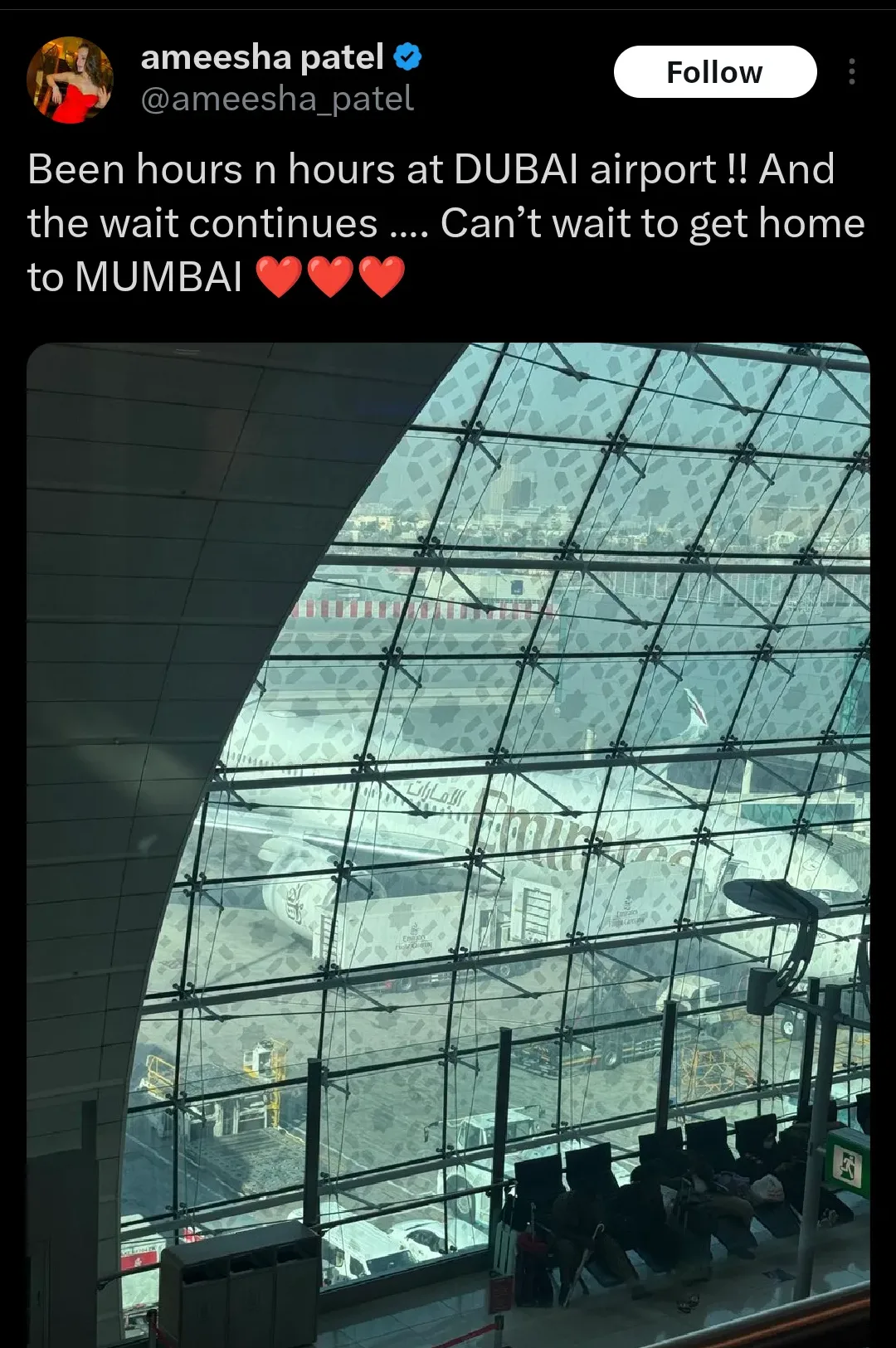

Patel was travelling with DJ Chetas and producer Kunal Goomer, who also shared glimpses of the delay from the airport lounge. Images circulating online showed the group waiting as flight operations across the region were affected.
The disruption is part of a broader pattern of aviation disturbances linked to heightened tensions in the Middle East. Missile and drone activity targeting the UAE has led to intermittent airspace restrictions, forcing airlines to reroute or delay flights as a safety precaution.
Such incidents underline how geopolitical conflicts can have immediate consequences beyond borders, affecting not just military or political stakeholders but also ordinary travellers and global mobility. Temporary airspace closures, though precautionary, can create ripple effects across international flight networks.


Patel’s experience quickly gained traction online, with many users expressing concern over her safety while also reflecting on the unpredictability of travel in conflict-affected regions. The episode also drew attention to the challenges airlines and aviation authorities face in ensuring passenger safety amid rapidly evolving situations.
Despite the disruption, Patel continued to update her followers, maintaining transparency about her journey and the delays she encountered. Her posts offered a glimpse into the uncertainty faced by passengers caught in such situations, where decisions are driven by security concerns rather than schedules.
The incident serves as a reminder of how global events can intersect with everyday life, turning routine travel into an unexpected ordeal. For Patel and others on board, what began as a standard international journey became a prolonged and uncertain experience shaped by forces far beyond their control.