
 Himshikha Shukla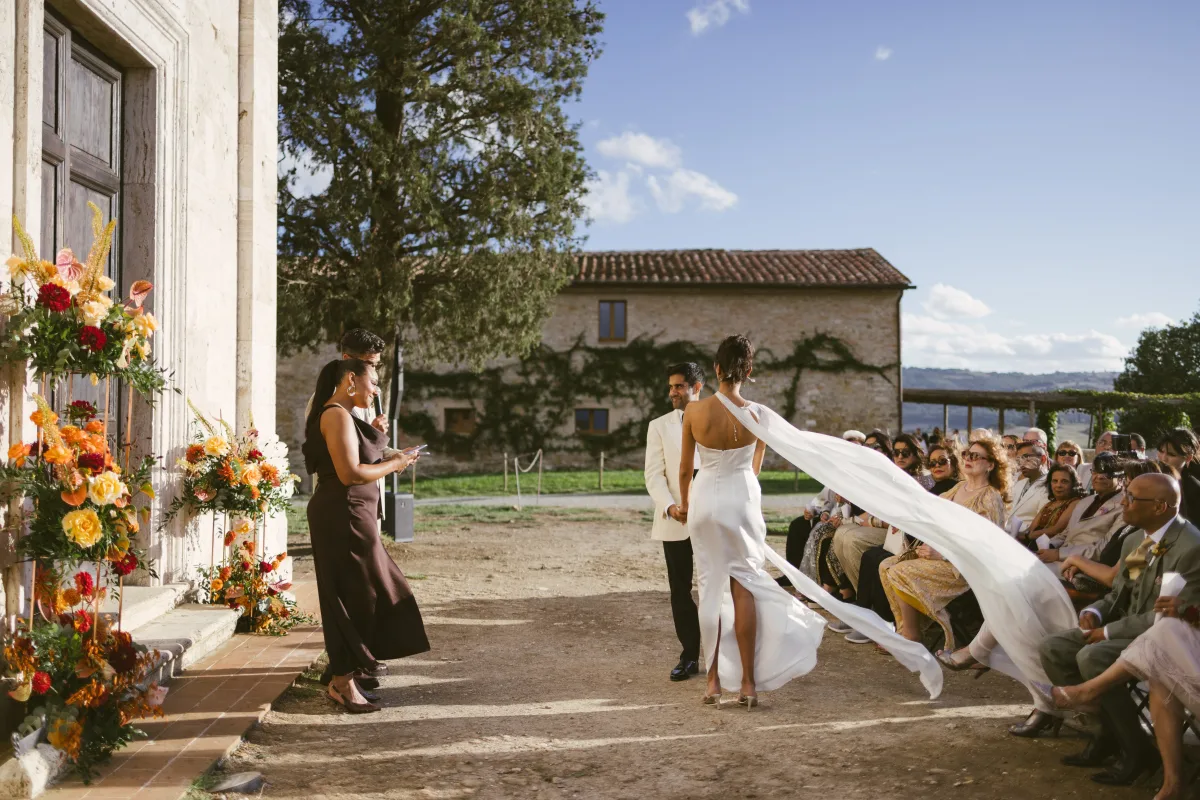
Across the world, couples are increasingly choosing to celebrate their weddings not in a single tradition, but in two, or more, at once. For couples whose families carry different cultural or religious backgrounds, a wedding day is no longer a choice between one heritage and another, it’s a chance to honour both, fully and equally. Tuscany, with centuries of history behind it and an instinct for improvisation and beauty, has quietly become one of the most sought-after backdrops for exactly this kind of celebration. It isn’t only that a destination wedding in Tuscany photographs beautifully. It’s that the region is flexible enough to hold two rituals, two families and two histories in the same golden afternoon.

The Real Challenge of a Fusion Wedding
Planning a wedding that blends two cultural traditions is considerably harder than planning one that follows a single script. Every decision, the venue, the officiant, the order of ceremonies, the food, carries a risk: get it wrong, and one tradition ends up feeling like decoration rather than substance. Both families need to feel equally seen and equally celebrated. That takes a planner who treats each heritage as the main event in its own right, never as a “theme” layered over the other.
A Real-Life Fusion: Anjli Mohindra & Sacha Dhawan
One of the clearest examples of this approach in practice is the wedding of actors Anjli Mohindra and Sacha Dhawan, planned end-to-end by Unique Events in Tuscany. Both of Indian heritage and based in the UK, the couple wanted a celebration that was, in their words, “unpretentious, playful and personal.” After touring venues across the region, planner Alice Bracciali proposed a wild card: Bagno Vignoni, a tiny medieval hamlet in the Val d’Orcia built around a single, iconic feature, a Renaissance-era thermal pool at the very centre of its main square. The moment the couple arrived, they knew it was the place.

Their Hindu ceremony was held in the historic portico that wraps around Bagno Vignoni’s iconic thermal basin, its stone arches lending the ritual the same quiet grandeur the hamlet has offered visitors for centuries. Later, the couple’s Western ceremony took place at the Cappella della Madonna di Vitaleta, a tiny chapel and UNESCO World Heritage site standing alone among the Val d’Orcia’s cypress-lined hills. The bride wore a custom lehenga; the groom, a pastel sherwani for the Hindu rites and a tailored suit for the evening that followed, complete with an Indian-inspired feast from local chefs, live music and dinner served beneath the stars. Best man Jonathan Bailey, of Bridgerton fame, added his own tribute to the day in a white kurta and teal Nehru jacket, a small but telling detail: even the wedding party dressed with the same cultural fluency the ceremony itself demanded. Read the full story, with the amazing photos by Beatrice Moricci from both ceremonies, here.

What Makes a Fusion Ceremony Work
Behind the photographs, a handful of principles hold this kind of wedding together.
Choose a territory that can host both rituals authentically, rather than a single venue stretched to fit two different ceremonies. Anjli and Sacha didn’t compromise on one location: the Sienese countryside gave them Bagno Vignoni’s historic portico for the Hindu rites and, a short drive away, the standalone Cappella della Madonna di Vitaleta for the Western ceremony, two distinct places, each fully significant, neither borrowing weight from the other.
Bring in vendors who understand the specific requirements of each tradition, from catering to floristry to music, rather than approximating them from the outside. Authenticity shows in the details guests never think to question.
Give each family a moment that is unmistakably theirs. A fusion wedding isn’t a blend where the two traditions dissolve into each other. It’s two full ceremonies, back to back, each carrying its own weight and its own meaning.

Let the setting do some of the symbolic work. A stone hamlet with a thousand years of history doesn’t need heavy styling to feel significant to two cultures at once. It already carries weight for both.
Tuscany, Ready for Every Tradition
As more couples look beyond a single cultural script for their wedding day, Tuscany’s appeal keeps growing, not despite its Renaissance stones and centuries-old chapels, but because of them. A region that has hosted every kind of celebration for so long finds it entirely natural to host two traditions at once. For couples planning a wedding that reflects exactly who they are, that kind of adaptability, paired with a planner fluent in more than one tradition, makes all the difference.