
 Snehashish roy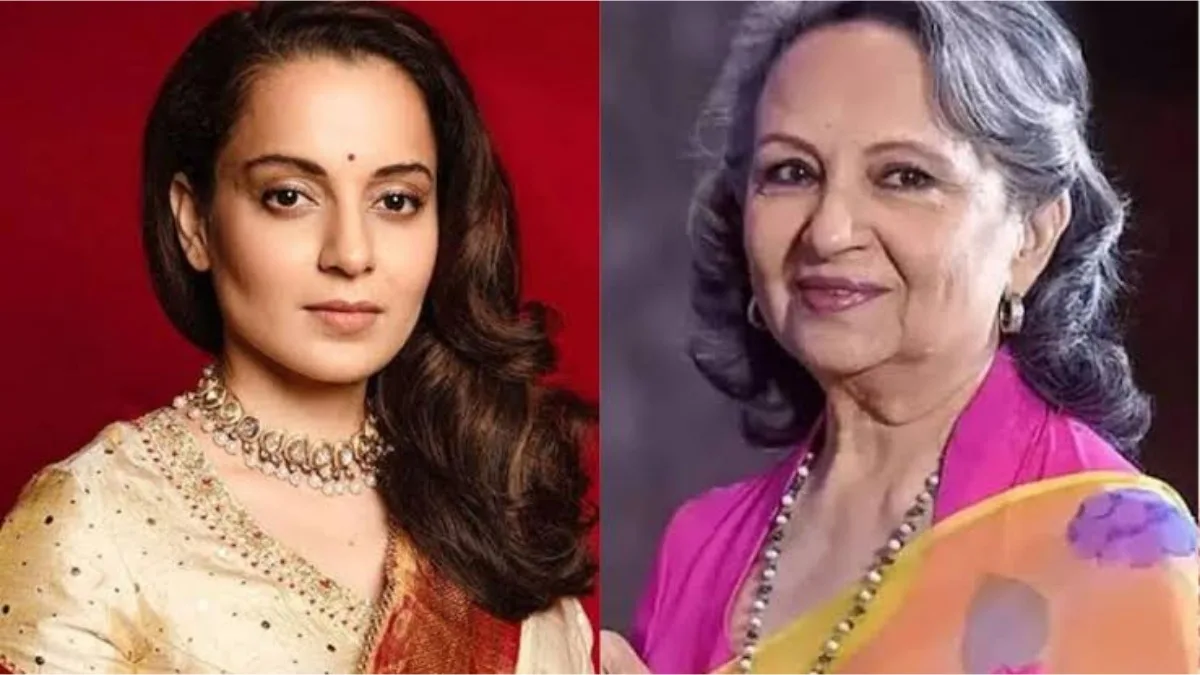
Actor-politician Kangana Ranaut has hit back at veteran actor Sharmila Tagore over her recent comments on Vande Mataram, saying she was “shocked” that an artist would view the national song primarily through a religious lens. Ranaut argued that the song should be understood in the context of art, metaphor and India’s freedom struggle rather than reduced to a Hindu-Muslim debate.
The controversy began after Sharmila Tagore expressed reservations about some portions of Vande Mataram. While discussing the song, Tagore reportedly said she was comfortable with the first two stanzas but felt the later portions, which contain references to Hindu deities, could be difficult for people belonging to monotheistic faiths to embrace.

Tagore’s comments have come amid a wider political debate over the national song and how it should be performed and interpreted. Vande Mataram, written by Bankim Chandra Chattopadhyay, became an important symbol of India’s freedom movement and was later accorded the status of India’s National Song.
Ranaut, however, disagreed with Tagore’s interpretation. Reacting to her remarks, the BJP MP said she was surprised that Tagore, as an artist, had what she considered a “limiting” view of the song.
Ranaut argued that poetry should not always be interpreted literally. She pointed to the use of metaphors and artistic imagination in literature and said references to Shakti should not necessarily be viewed solely as religious references. Instead, she suggested that they could represent strength and empowerment.

The actor-politician also urged Tagore to move beyond what she described as a “Hindu-Muslim mindset”. Ranaut’s argument was that Vande Mataram represents the spirit of India’s independence movement and should be viewed as a national and cultural symbol rather than through the prism of religious identity.
The disagreement highlights a long-running debate surrounding the complete version of Vande Mataram. While the opening stanzas celebrate the motherland through imagery of its landscape and natural beauty, later verses invoke Hindu religious imagery, including references to goddesses.
The question of which portions should be sung at public and national events has therefore periodically generated controversy. Historically, concerns over the religious references were also considered when the song was adopted as India’s National Song. The first two stanzas were generally regarded as suitable for wider national use because of their focus on the motherland.

Ranaut’s response comes against the backdrop of her increasingly vocal participation in debates involving nationalism, religion, culture and politics. Since entering electoral politics, the actor has frequently used social media to express strong opinions on contentious national issues.
Her latest comments also underline her belief that cultural and artistic symbols should not necessarily be interpreted exclusively through religious identity.
Tagore’s position, meanwhile, has been presented as a question of inclusivity rather than a rejection of the song itself. Her reported preference for the first two stanzas reflects concerns that portions invoking Hindu deities may not resonate equally with citizens belonging to monotheistic religions.