
 Snehashish roy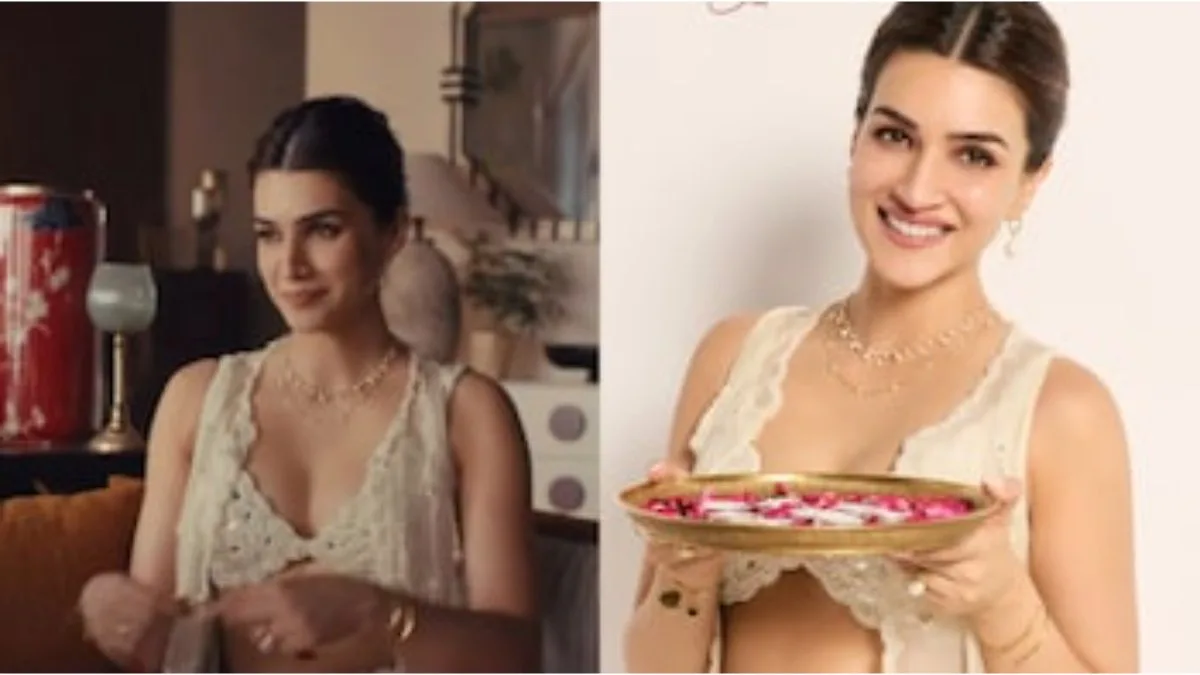
Kriti Sanon has responded to the backlash surrounding her recent Raksha Bandhan jewellery advertisement, questioning why women continue to be judged on their clothes during traditional festivals. Defending the campaign, the actor said the essence of a festival lies in the emotions and values associated with it, rather than in what a woman wears.
The controversy erupted after Kriti featured in a GIVA jewellery advertisement for Raksha Bandhan. In the campaign, she is seen wearing an Indo-Western ensemble comprising a bralette-style blouse, a cape and a draped skirt while celebrating the festival with her onscreen brother. She is also shown tying a rakhi to a pet dog, a creative choice that attracted criticism from some viewers.

A section of social media users questioned Kriti’s outfit, arguing that it was inappropriate for an advertisement centred on a traditional Indian festival. Some also objected to the portrayal of the rakhi ritual and the inclusion of a dog.
One user questioned the absence of traditional elements such as a puja thali and tilak, while another asked why Kriti was wearing what they considered a revealing outfit while celebrating Raksha Bandhan with her brother. Others accused the brand of deliberately presenting the festival in a way that ignored its traditional character.
The backlash intensified after actor-politician Kangana Ranaut also criticised the advertisement. Ranaut questioned why someone would tie rakhi to their brother while wearing what she described as a bikini-like outfit, adding another prominent voice to the criticism.

Kriti has now directly addressed the criticism through her Instagram Stories.
Responding to the controversy, Kriti argued that festivals should not be reduced to questions about clothing.
She wrote that the essence of festivals lies in the emotions and meaning people attach to their traditions. She explained that Raksha Bandhan represents a bond of protection and said that she and her sister tie rakhi to each other because they believe they can protect one another just as much as a brother can.
Kriti also defended the advertisement’s decision to include pets. She said that the promise and prayer associated with the festival extend to dogs as well because they are part of the family.

The actor then directly questioned the broader social tendency to police women’s clothing.
She argued that ethnic fashion has evolved over the years, but women continue to have their respect for Indian culture judged primarily through their clothes.
Her most pointed remark was that “Culture & Traditions are in her heart, not in her neckline.”
Kriti’s response came after a section of her fans and social media users had already defended the advertisement.
Some argued that the actor was being subjected to a double standard. They pointed out that audiences readily celebrate celebrities wearing revealing outfits in films but become critical when similar fashion choices appear in a festival-themed advertisement.

One supporter argued that women are judged regardless of what they wear and said the criticism was less about the advertisement and more about imposing a particular definition of “decency” on women.
Others praised GIVA for attempting to present Raksha Bandhan through a more contemporary lens and welcomed the idea of treating pets as members of the family.
Kriti’s outfit was not the only aspect of the advertisement that generated criticism.
The campaign shows her tying a rakhi to a pet dog, apparently extending the idea of siblinghood and protection to animals. Critics questioned whether this trivialised a festival traditionally associated with the bond between brothers and sisters.
Pet lovers and other supporters, however, defended the creative decision, arguing that animals are increasingly regarded as members of families and that there was nothing inherently disrespectful about including a pet in a celebration.
The disagreement has consequently turned into a larger debate about how much traditional festivals should evolve in contemporary advertising.
At the heart of the controversy is a familiar question: does a woman’s clothing determine how seriously she respects her culture?
In this case, GIVA’s campaign has divided audiences between those who see it as a contemporary interpretation of Raksha Bandhan and those who believe the advertisement crosses the line between modernisation and dilution of tradition.