
 Himshikha Shukla
Walk around the outside of an average American home and count the things that haven’t been touched by the last two decades of technology. The thermostat has an app. The doorbell has a camera. The garage door opens from a phone. The irrigation system checks the weather forecast before deciding whether to run. Even the exterior lights have probably been swapped for something that dims on a schedule.
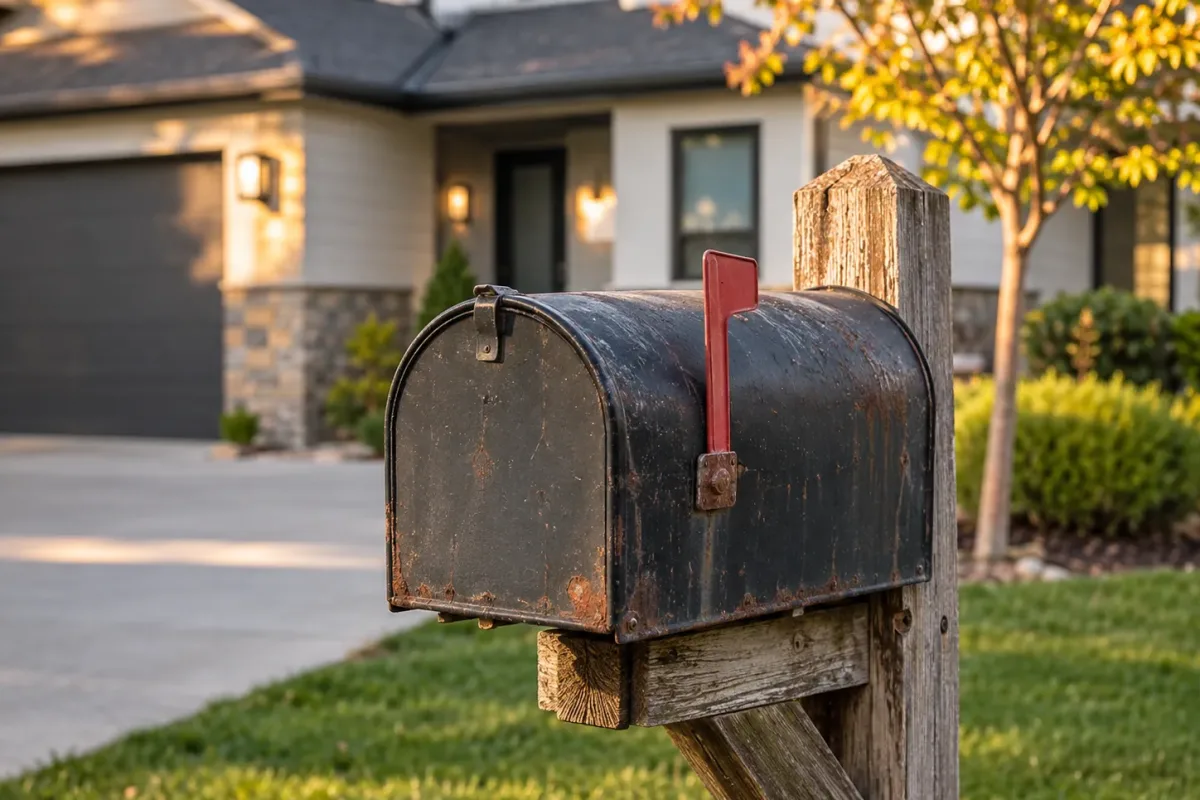
Then there’s the mailbox: a metal box on a stick, functionally identical to one your grandparents would have recognized, sitting at the end of the driveway handling the most sensitive documents that arrive at the property each year. It’s genuinely the last fully analog object on most residential lots — and that status is worth examining rather than simply accepting, which is partly why specialists like Mailbox Avenue have built entire catalogs around the gap between what a mailbox does and what most of them are actually equipped to do.
Designed for 1915, Deployed in 2026
The standard curbside mailbox form was finalized in 1915 by Roy Joroleman, an engineer at the Post Office Department. He gave it an arched dome so snow and rain would shed rather than pool, a hinged front door, and a flag for signaling outgoing mail. It was cheap to stamp from sheet steel, visible at speed from a passing vehicle, and sized for the correspondence of its era.
It was a genuinely excellent design. That’s precisely why it never changed.
The problem is that the system feeding it changed completely. Letter volume has declined steadily for twenty years while parcel volume climbed in the opposite direction, and the average household now receives several packages a week alongside its mail. A receptacle optimized for envelopes and the occasional catalog is being asked to absorb an entirely different category of delivery, and it does so badly — which is why so many homes have normalized the sight of a box that won’t quite close and a package sitting on the porch in whatever weather the afternoon brought.
The Security Question Nobody Asks Out Loud
The more consequential issue is what passes through that unlocked container over a year.
Bank statements. Tax documents. Insurance correspondence. Replacement cards. Medical notices. Government mail. Checks. The informational value moving through a residential mailbox in twelve months dwarfs the cost of the mailbox itself, often by a factor of several hundred.
And roughly two-thirds of American homes still use a mailbox with no locking mechanism whatsoever — a door that opens with a fingertip, on a public street, unattended for the several hours between delivery and whenever someone gets home to collect it.
Framed that way, the arrangement sounds absurd, because it is. Nobody would leave a folder containing their account numbers and tax records in an unlocked box at the curb. Functionally, that’s the arrangement. The only reason it doesn’t feel absurd is that it’s universal, and universal arrangements stop registering as choices.
The U.S. Postal Inspection Service handles tens of thousands of mail theft complaints annually, and the real figure is understood to be considerably higher, because most victims don’t discover the theft until a fraudulent charge appears weeks later — at which point the connection back to a missing envelope is nearly impossible to establish.
Why the Upgrade Doesn’t Happen
Three reasons, and none of them are cost.
It never fails outright. A mailbox degrades gradually and keeps technically working the entire way down. There’s no moment that forces a decision the way a failed water heater does. The door that doesn’t seal still holds mail. The stiff lock still turns, eventually. The box too small for packages still receives letters. Nothing ever crosses a line clear enough to prompt action.
Nobody owns the decision. There’s no building code requiring adequate mailbox capacity, no inspection that flags a non-locking box, no renewal date, no warranty expiry. Every other piece of exterior infrastructure has some external pressure attached to it. The mailbox has none.
It’s invisible precisely because it’s always visible. The thing you walk past twice a day stops being something you see. Homeowners who notice a chipped baseboard inside the house will walk past a rusted mailbox for three years without registering it, because it’s become part of the landscape rather than part of the property.
What Changing It Actually Involves
This is the part that makes the whole situation slightly ridiculous: the fix is among the smallest projects available on a residential property.
Replacing a mailbox on an existing post is a twenty-minute job with a screwdriver. A full replacement including a new post is an afternoon. There are no permits for a standard installation, no contractors, no quotes, no scheduling, no dust, no disruption to anything. The materials cost less than a single piece of patio furniture.
For something that’s simultaneously the first thing every visitor sees, the daily custodian of your financial correspondence, and the last object on the property that technology forgot — that’s an unusually favorable ratio between effort and outcome.
Worth a walk down the driveway this weekend, looking at it properly for the first time in years.