
 Himshikha Shukla
From the fluid drapes of ancient India to the modern sari, lehenga and Indo-Western wardrobe, Indian women’s clothing has constantly evolved. The recent GIVA controversy raises a larger question: when did an outfit become a test of culture, and why are we spending so much public energy debating it?
For a country with one of the oldest and most diverse textile traditions in the world, India has developed a surprisingly rigid contemporary vocabulary around the word “traditional”. We use it casually, almost as though its meaning were self-evident. A sari is traditional. A lehenga is traditional. A salwar-kameez is traditional. A deep blouse may invite debate. A bralette-style blouse may suddenly become “Western”. An Indo-Western ensemble can be labelled inappropriate for a religious festival. Yet the history of Indian women’s clothing tells a far less orderly story. Across centuries, women in the subcontinent have worn draped lower garments, breast bands, transparent fabrics, shawls, fitted bodices, long tunics, skirts, elaborate girdles, stitched jackets and garments that left the waist, shoulders and sometimes the upper torso uncovered. What we call traditional today is therefore not an unchanged inheritance from some single ancient Indian wardrobe. It is the result of centuries of evolution, regional diversity, social change and reinterpretation.
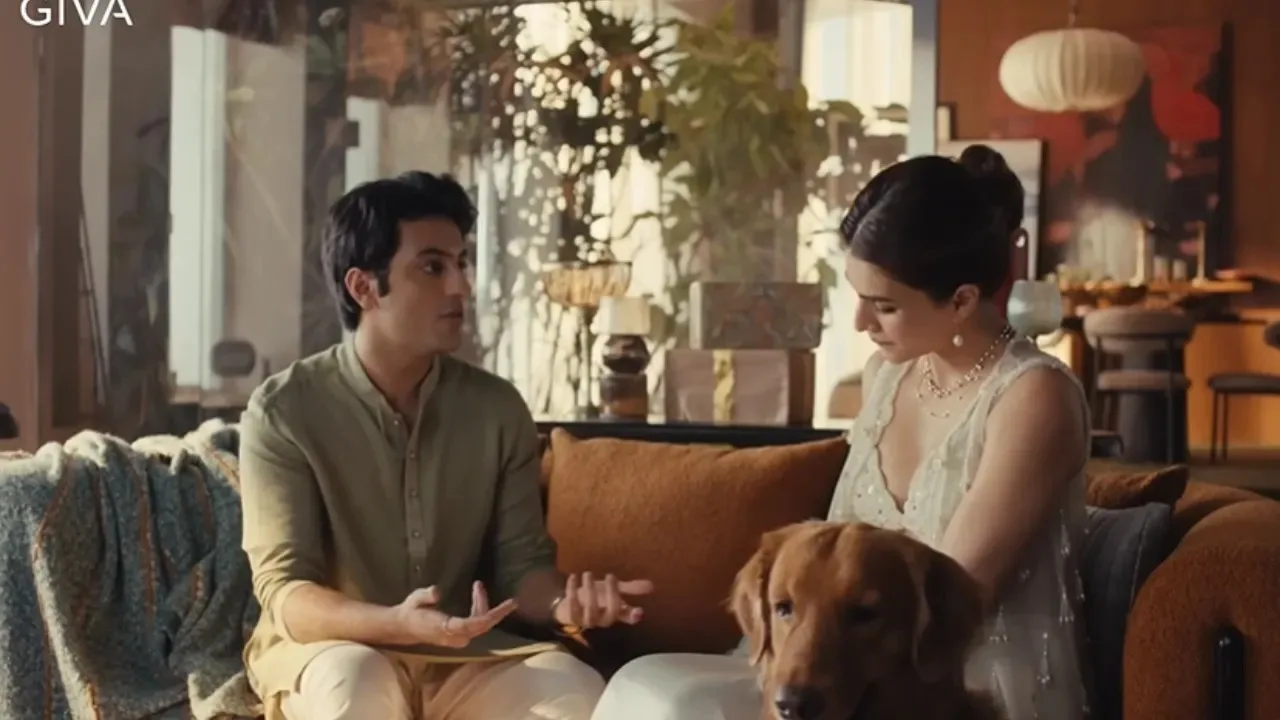
This distinction became unexpectedly relevant when jewellery brand GIVA released its 2026 Raksha Bandhan campaign featuring Kriti Sanon. In the advertisement, Sanon appeared in an off-white Indo-Western ensemble comprising a bralette-style blouse, cape and draped skirt. The campaign also broadened the conventional brother-sister interpretation of Raksha Bandhan by including sisters protecting one another and a rakhi being tied to a pet. Almost immediately, parts of social media objected. Some viewers felt that the styling did not suit the emotional and ritual character of Raksha Bandhan. Others objected to the pet element. But much of the discussion quickly centred on Sanon’s clothing and whether it was appropriate for an Indian festival.
The conversation intensified after actor and BJP MP Kangana Ranaut criticised the campaign and questioned why a woman would tie a rakhi dressed in something she compared to undergarments. Sanon responded by challenging the very idea that a woman’s relationship with culture can be measured through her clothing. She argued that the essence of a festival lies in its emotions and meaning rather than the clothes one wears, and explained that she and her sister tie rakhis to each other because protection is not exclusively a brother’s responsibility. Their dogs, she added, are part of their family too. Her response culminated in a line that quickly became central to the debate: culture and traditions are in a woman’s heart, not her neckline.
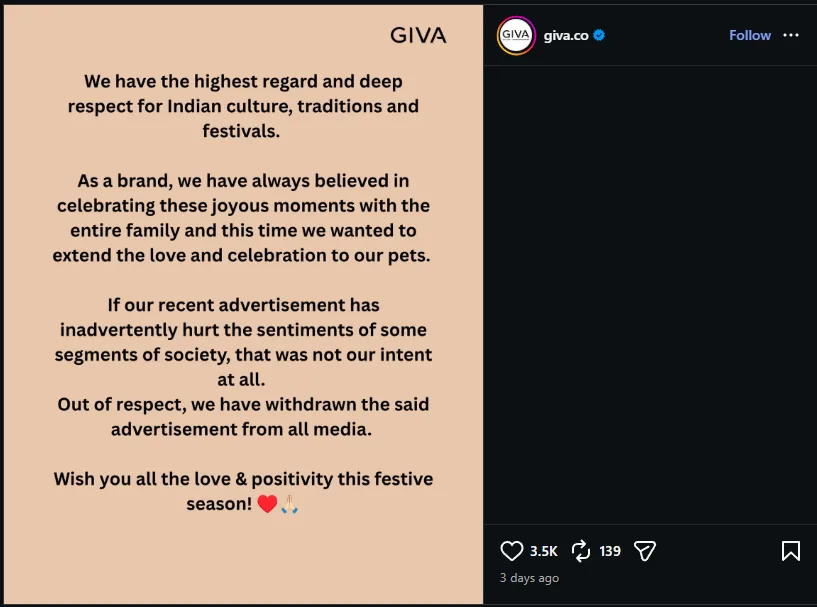
The disagreement then grew beyond fashion and advertising. Political leaders entered the conversation. Celebrities commented. Social media divided itself into camps arguing about culture, personal freedom, religious sensitivity, feminism and double standards. GIVA eventually withdrew the campaign, saying that it respected Indian culture and traditions and had not intended to hurt sentiments. What began as an advertisement for jewellery had turned into a national discussion about what a woman should wear while participating in a festival.
There is a legitimate advertising question here. Festivals carry emotional and visual associations, and brands deliberately use them to build commercial narratives. A consumer is perfectly entitled to feel that a campaign lacks the warmth, rituals or familial setting normally associated with Raksha Bandhan. Advertising is communication, and when a significant part of the audience interprets the communication differently from what the brand intended, that deserves examination. One can reasonably ask whether GIVA became so focused on producing a fashionable contemporary image that the festival itself became visually secondary. Criticising that creative decision is not the same as policing a woman’s body. The difficulty arose when the debate shifted from whether the advertisement successfully represented Raksha Bandhan to whether Sanon’s neckline was compatible with Indian culture.
History makes that second argument considerably more complicated.
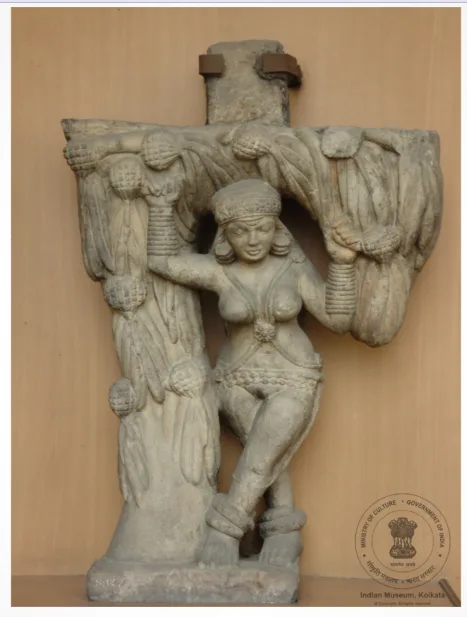
Travel back roughly two thousand years and the visual vocabulary of women’s dress changes dramatically. The celebrated Sanchi Yakshi, dating to approximately the first century CE, is described by the Indian Museum as being almost nude except for an extremely fine garment whose edges are visible around the hips and below the knees. This figure was not hidden from public view in shame. She formed part of the artistic programme of one of India’s most important Buddhist sites. Yet this should not lead us to the equally simplistic conclusion that ancient Indian women generally walked around bare-bodied. Other archaeological representations from neighbouring periods show women in considerably more elaborate and extensive drapery. Ancient Indian dress was already diverse.
Ajanta deepens the story considerably. Unlike stone sculpture alone, the paintings at Ajanta preserve colour, layering, shape and hints of textile texture. Women appear in saris and skirt-like garments, fine gauze bodices, half-sleeved jackets, tunics, breast bands, scarves and stitched garments. An Archaeological Survey study of Ajanta notes that women of position were depicted in striped skirts and sari-like garments, sometimes with half-sleeved jackets or fine gauze bodices, while attendants could appear in full- or half-sleeved tunics, cholis, breast bands and jackets. There is no single uniform costume even within one artistic complex.
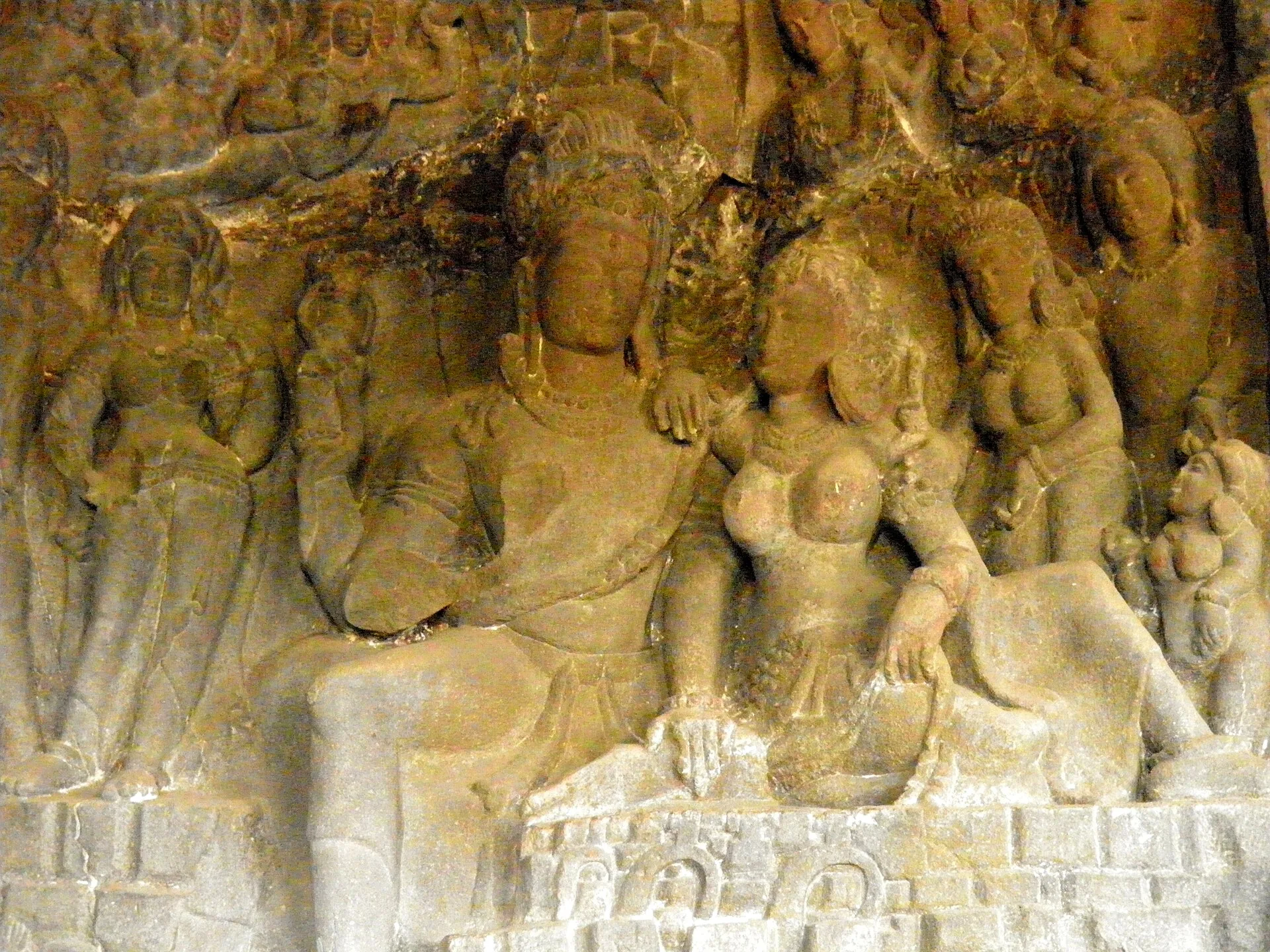
This is crucial because modern conversations often imagine Indian clothing history as a simple battle between “traditional covering” and “modern revealing”. Ajanta refuses that binary. A woman could be extensively draped and still have an exposed waist. Another could wear a breast band rather than a tailored blouse. Another could wear a tunic. Another might appear in a fabric so fine that the body remained visually prominent. Beauty, ornamentation, sensuality and respectability did not always exist in the oppositional categories through which contemporary social media interprets them.
The terminology of classical Indian clothing reinforces this variety. The antariya broadly referred to a lower garment or drape. The uttariya functioned as an upper cloth that could be arranged across the body, shoulders or head. Breast coverings existed in different forms and are discussed using terms such as stanapatta, stanamsuka and stanottariya. Stitched garments were also part of Indian clothing history. Forms of the kanchuka, for example, could function as bodices, jackets or tunics. The idea that stitched upper garments were completely foreign to India is therefore incorrect, just as it is incorrect to imagine that an uncovered waist or minimally covered upper torso was inherently foreign to Indian aesthetics.
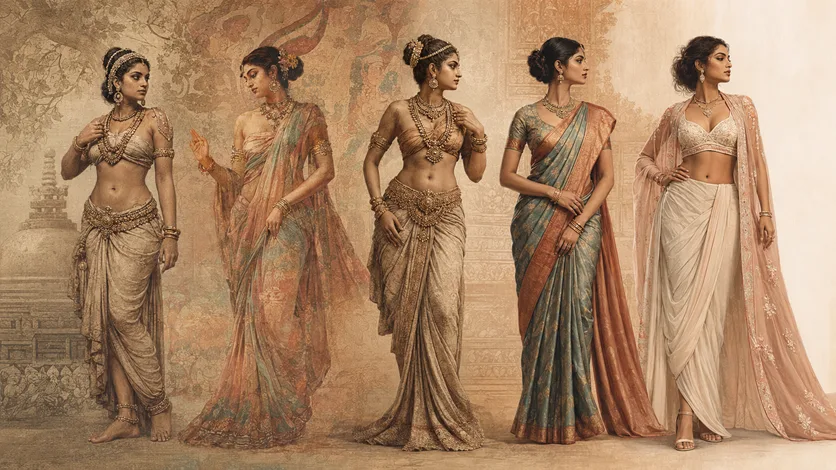
More Images on Fashion And Jewellery of Ancient Women: https://vgopalan.myportfolio.com/fashion
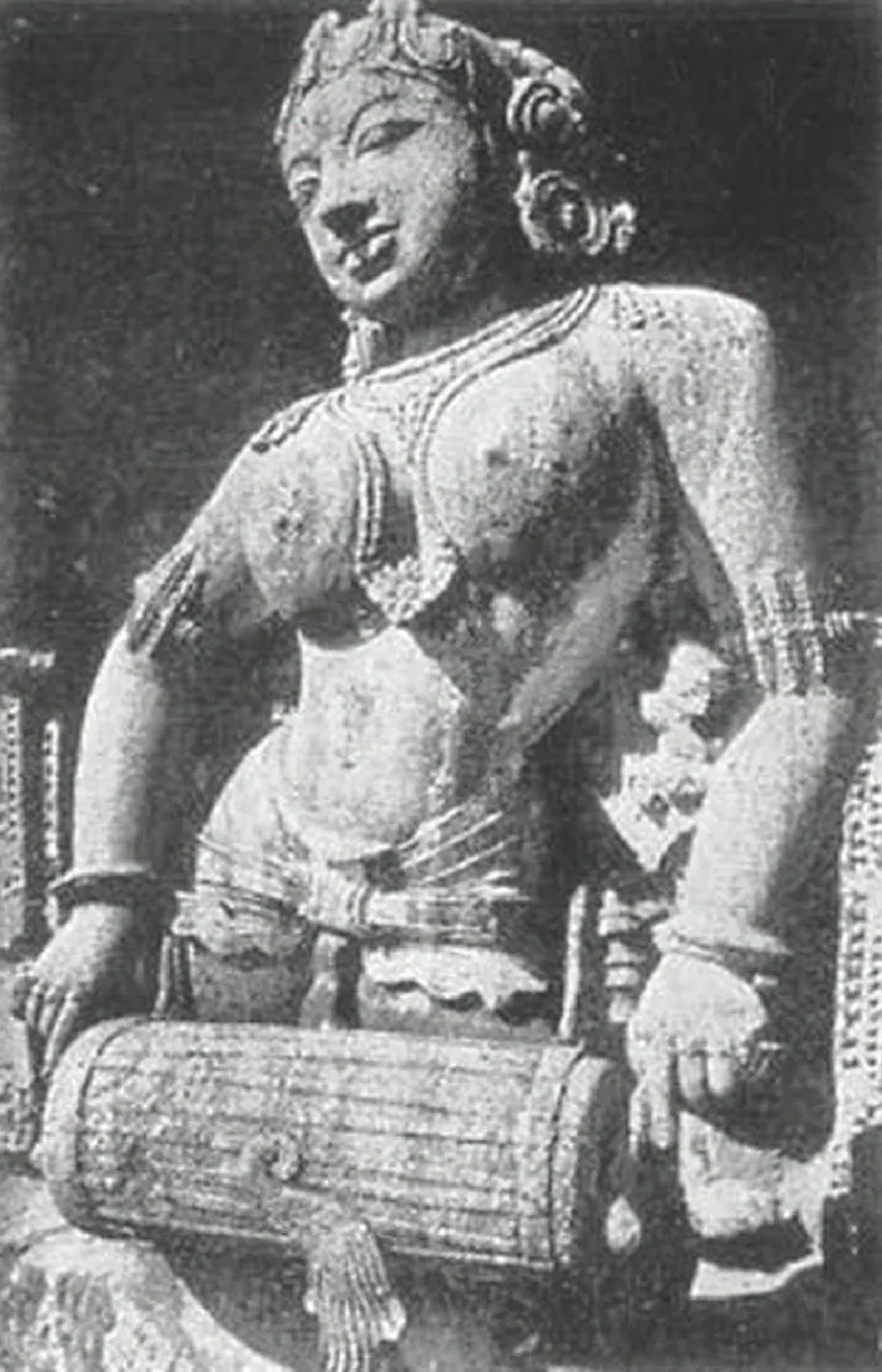
Move forward several centuries to the Sun Temple at Konark and the visual language continues to challenge contemporary assumptions. The National Museum’s description of a 13th-century Surasundari from Konark records her wearing a stanottariya and nivi-bandha, accompanied by elaborate jewellery and an emphasised slender waist. The female body in temple art is frequently graceful, sensual and highly ornamented. The abdomen, waist and curves are not necessarily concealed. This does not mean a temple sculpture can be treated as a literal record of what every ordinary woman wore to the market. Religious and courtly art follows symbolic and aesthetic conventions. But it does demonstrate something important: exposure of parts of the female body was not automatically understood as an assault on Indian civilisation.
The broader scholarship on Indian costume reaches the same conclusion about continuous evolution. Roshen Alkazi’s Ancient Indian Costume, published by the National Book Trust and based substantially on archaeological sources, traces clothing between the ancient period and approximately the ninth century CE, examining changing costumes, textiles, jewellery, headgear and hairstyles. The very existence of such an evolutionary history is a reminder that Indian costume cannot be reduced to one timeless ensemble.
What we now recognise instantly as “traditional wear” emerged through this process of change. The sari is an extraordinarily old draped tradition, but the manner in which it is worn has differed dramatically across regions and centuries. Even today, a Bengali sari, Maharashtrian nauvari, Tamil madisar, Kodagu sari and contemporary urban sari are not identical forms. The blouse beneath the sari has its own history of changing cuts, sleeves, necklines and social meanings. The salwar-kameez carries histories linked to regional and courtly cultures. The lehenga-choli has transformed repeatedly in silhouette and construction. Fabrics, embroidery techniques, tailoring, colonial contact, princely courts, trade routes, cinema and global fashion have all contributed to what we now place under the convenient umbrella of “Indian traditional wear”.
Colonial India brought another important layer. Victorian standards of propriety interacted with Indian elite society, particularly in urban and colonial social spaces. The increasingly structured combination of sari, tailored blouse and petticoat became prominent in sections of society during this period. This does not mean that blouses were simply a British invention. Stitched upper garments existed in India much earlier. What changed was the social standardisation of certain combinations and ideas of respectable public dress. Over time, these adaptations became so completely naturalised that subsequent generations inherited them as tradition.
This is how tradition actually works. It absorbs change and then forgets that the change was once new.
What one generation describes as unconventional can become the next generation’s normal. The sleeveless blouse was once provocative in many households. Later it became ordinary. The deep-backed blouse, halter blouse, sari gown, crop-top lehenga and pre-draped sari have all moved through various stages of resistance, glamour, acceptance and commercialisation. Designers routinely return to ancient silhouettes, temple jewellery, regional textiles and historic drapes while combining them with contemporary tailoring. We call the result fusion, but fusion itself has been part of Indian dress history for centuries.
This does not automatically make Kriti Sanon’s GIVA outfit “traditional”. It would be equally lazy to use Ajanta or Konark as proof that any contemporary fashion garment should therefore be classified as classical Indian dress. Sanon was wearing a deliberately modern Indo-Western ensemble. A person may reasonably feel that a conventional sari, salwar suit or lehenga would have better represented Raksha Bandhan. Personal and community ideas of appropriateness are real and cannot simply be dismissed by producing photographs of ancient sculpture.
The more important distinction is between saying, “This outfit does not represent the way I celebrate Raksha Bandhan,” and saying, “A woman dressed like this cannot represent Indian culture.” The first is a personal or aesthetic judgement. The second makes a much larger historical claim, and that claim is difficult to defend. India’s own visual and textual history demonstrates too many definitions of female clothing, modesty and adornment for a single neckline to become the boundary between Indian and un-Indian.
There is also a gender question that cannot be ignored. Women’s clothing repeatedly becomes shorthand for cultural anxiety. A woman can be criticised for dressing too revealingly and accused of disrespecting tradition, yet another woman may be criticised for covering herself too much and described as conservative or regressive. A sari can be called dignified, but change its blouse and the same sari can suddenly become provocative. A lehenga can be celebrated as heritage on one woman and condemned as excessive display on another. Female clothing operates inside a constantly shifting corridor of approval in which society often reserves the right to judge not merely the clothes but the character, morality and cultural authenticity of the woman wearing them.
That is why the GIVA debate became bigger than an advertising controversy. The disagreement touched an unresolved question within contemporary India: who has the authority to define culture? Is culture determined by scripture, family practice, historical precedent, regional custom, personal faith, popular convention or social-media consensus? And if all of these differ, whose version becomes compulsory?
There is another question that deserves even more attention: why did this controversy become so large in the first place?
India today faces extraordinarily demanding challenges. The country must improve the quality of school and higher education, create productive employment for a huge young population, improve healthcare access, expand manufacturing, strengthen exports, manage imports and energy dependence, modernise agriculture, build infrastructure, deepen scientific and technological capabilities, address environmental pressures and navigate an increasingly complex geopolitical landscape. Debates around women’s safety, workforce participation, financial independence, nutrition and healthcare remain enormously consequential. None of these issues makes cultural questions irrelevant, but they should affect our sense of proportion.
A jewellery advertisement can be criticised without turning it into a national emergency.
Public attention is not unlimited. Newsroom space, television airtime, political attention and social-media engagement all have an opportunity cost. Every hour devoted to a celebrity wardrobe dispute is not automatically stolen from an economic debate, but an ecosystem that repeatedly rewards symbolic outrage inevitably pushes more complicated subjects to the margins. An argument about a blouse produces an immediate emotional reaction. An argument about export competitiveness requires understanding freight costs, tariffs, currency movements, manufacturing productivity and global demand. One can choose a side in the former within seconds. The latter demands patience.
That is precisely why cultural controversies travel so efficiently through the attention economy. They are visual, personal, emotional and easily polarised. One image can produce outrage. One celebrity response produces another. Political involvement converts entertainment news into national news. Algorithms reward conflict, audiences reward certainty, and nuanced questions collapse into two camps shouting at each other. Before long, a private company’s styling decision appears to represent a battle between tradition and modernity.
The irony is difficult to miss. India possesses one of the richest histories of clothing on earth, yet our public conversation can reduce tradition to the width of a blouse. We have thousands of years of textiles, drapes, tailoring, ornamentation and regional variation to study, but it is easier to declare an outfit “against culture” than to investigate what that culture actually contained.
Perhaps GIVA misread the emotional language of Raksha Bandhan. Perhaps the styling was too fashion-forward for the story it wanted to tell. Perhaps consumers were right to question whether a festival should be stripped of familiar rituals merely to create a sleek commercial visual. These are worthwhile advertising questions. But they could have remained advertising questions.
Instead, the argument became a judgement on a woman’s clothing, then on culture, then on religious respect, then on personal freedom, and finally on political identity. The original advertisement almost disappeared underneath the controversy built around it.
Indian tradition deserves better than that simplification. It is neither so fragile that one bralette can destroy it nor so rigid that two thousand years of changing dress can be reduced to one approved silhouette. It contains Sanchi and Ajanta, Konark and regional handlooms, the sari and salwar, the lehenga and long tunic, the blouse and breast band, the veil and exposed waist. It contains adaptation precisely because it has survived.
We may continue to disagree about what should be worn to a festival. Families will have their preferences. Communities will have their customs. Individuals will draw their own lines. Brands will sometimes get the cultural balance wrong and deserve criticism for it. None of that threatens the existence of tradition.
The more serious danger may be our inability to distinguish between disagreement and crisis.
At a moment when India needs sustained public engagement with education, employment, economic growth, trade, technology, healthcare and its place in a changing world, we should perhaps ask why a celebrity’s blouse can command days of national attention. The answer may tell us considerably more about modern India than the GIVA advertisement ever could.
The important question, ultimately, is not whether Kriti Sanon was wearing enough tradition.
It is whether we are giving enough attention to the things that truly determine the country’s future.